US Large-Cap Craze: Investors Pour Record Billions into Vanguard S&P 500 ETF ($VOO)
- December 2, 2025
- Author - Team XALT
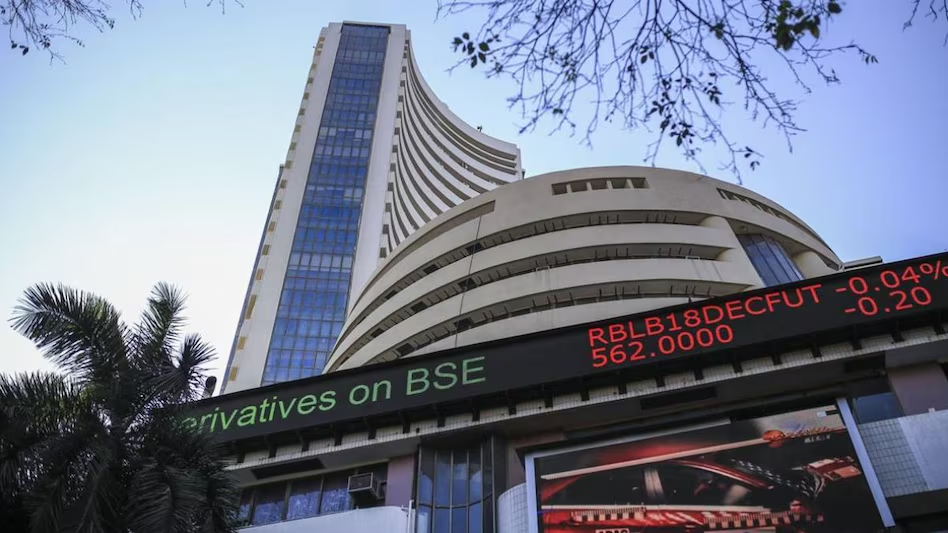
India’s equity markets have delivered their worst relative performance against emerging markets in three decades. The MSCI India index has gained a mere 2-2.5% in US dollar terms year-to-date, sharply trailing the MSCI Emerging Markets index’s 29% odd surge and the broader MSCI Asia Pacific ex-Japan’s 25% odd advance. This represents an underperformance gap of anywhere between 25-27 percentage points — the widest margin since at least 1993, and likely the worst relative showing in the post-liberalization era. For context, India’s benchmark indices have fared even worse in absolute terms: the Sensex has hardly gained in dollar terms (even as it has a 8.8% gain YTD in rupee terms), placing it among the worst performers globally. Korea’s KOSPI has surged over 50%, Germany’s DAX has gains of over 30%, and even Thailand’s index has managed to be ahead of India.
Unlike a domestic investor, a foreign investor has the choice of investing across multiple markets, and when a 24x PE market delivers 10% earnings growth, the writing is on the wall. This 10% earnings growth, if Indian markets manage that, represents a significant downgrade from historical growth rates of 12–16%, reflecting a cyclical slowdown in the Indian economy that has persisted throughout 2025, and is likely to show some revival only because of measures taken by the Government and RBI. But even as these expectations were getting absorbed, there has been a persistent weakness in the Indian rupee, showing up arguably amongst the poorest performances among major Asian currencies against the dollar. It even breached the psychologically critical Rs 90 level in December. Mind you, the performance of some of the other currencies like the Euro is even worse. This currency headwind alone materially reduced dollar-denominated returns for foreign investors, compounding the equity market weakness.
Vs USD – 7%
Vs GBP – 15%
Vs Euro – 20%
Severe Foreign Capital outflows were amongst the principle reasons for the rupee weakness. FIIs have executed near-record net selling of over 15 billion dollars in 2025, driven by three factors – Superior relative returns in developed markets, particularly the US; Investor rotation toward North Asia (China and South Korea) for exposure to artificial intelligence and semiconductor stocks, where India lacks a compelling narrative, and the preference for buying gold, with 2025 returns making gold returns better than Sensex for any 5 year time block dating back 25 years. This reallocation reflects the view that emerging markets like India do not offer the same AI-driven growth catalysts or safety of stability.
The 2025 underperformance, while severe by modern standards, reflects a cyclical convergence rather than a structural rupture: India’s valuation premium has compressed, earnings have disappointed, and capital has reallocated based on relative value and growth narratives elsewhere. The question is — can this change? The answer, while not an unequivocal yes to many, seems to have shades of optimism and there are multitude of factors for the same.
Firstly, earnings growth may show a ramp up. The GST cut and the efficient lending led by lower rates may bring a spurt in consumption. That may spur some capex in consumer-oriented sectors. If all of this leads to earnings growth, then we are looking at a better FY27. And brokerage note after brokerage note is screaming about a 14-18% earnings growth in FY27. Add to that the fact that while India lacks an AI narrative, it becomes a compelling anti-AI trade, which may play out in 2026.
Technically, the extent to which the global investors are underweight India is unparalleled this decade. And if FIIs were to even reverse the US stance, and if outflows get stemmed, and the rupee stabilises partially, it may well help the cause of getting flows into India. A steady supply of IPOs and foreign outflows were enough to absorb the impact of heavy domestic buying in 2025. Imagine the same buying continues (Indian equity mutual funds recorded net inflows of around 4 lakh crore rupees YTD), but is accompanied by lower outflows, which pale in comparison to 2025, and we may well have a technical trump card (pun isn’t intended) in our hands.
Lastly, a thing that I have learnt in these last twenty years of looking at equity markets is never fight the regulator. In my mother tongue Gujarati, the saying goes as such – ‘Satta saame shaanpan nakaamu’ (Dont act smart versus the Government). The RBI has loosened monetary policy meaningfully to give a stimulus to the economy. The Government has given a stimulus in form of the GST cuts and with the backs to the wall due to the US tariffs, the Government has gone on an overdrive of reforms. If this were to continue, you are fighting the establishment if you are short India. In my humble opinion – Not a good idea. And I think 2026 will bear that out.
A small swadeshi pitch as we wrap 2025. In Bloomberg’s annual 25 best places to visit this year, the Indian Tiger Safari Reserves found a mention. I strongly urge people to give these safaris a chance. Book (well in advance) with the right agents, stay at the right places, enjoy the hospitality and see some wonderful tigers. My bet is that you will be enthralled with the experience of chasing and seeing the majestic Indian tiger.
Have a great new year everyone!